Hinduism allows for many representations of God in both male (Deva) and female (Devi) forms even though all forms are a manifestation of Brahman, the formless manifestation of God. Karya Siddhi Hanuman Temple has seven main deities (described in this page) that were consecrated by His Holiness Sri Ganapathy Sachchidananda Swamiji. While the main deity is Sri Marakata Karya Siddhi Hanuman, the temple celebrates all major Indian festivals with their associated deities.
Temple Deities
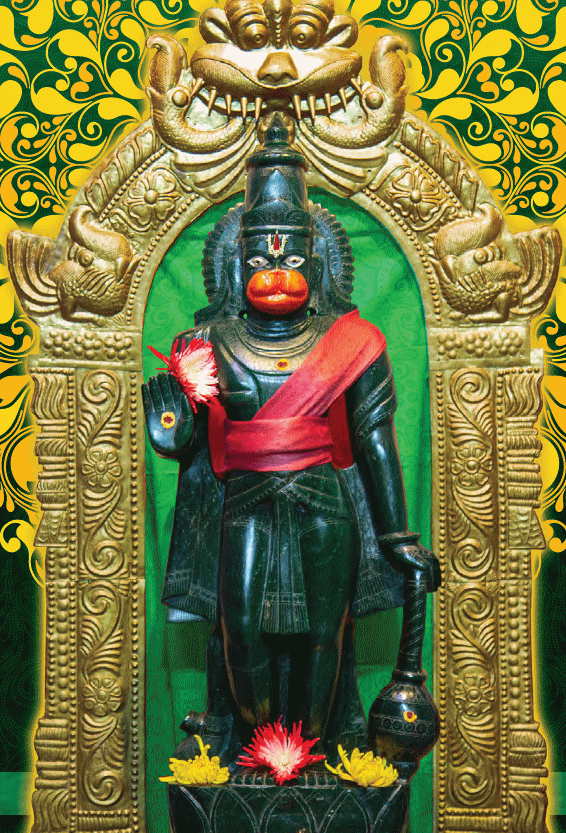
Marakata Karya Siddhi Hanuman
Sri Hanuman is Chiranjeevi and is present at all times. Considered to be Para Brahma, Lord Hanuman is also a specialist in the nine types of devotion with an excellent character worthy of emulation by all. With His undying devotion, Sri Hanuman’s greatness lies in His complete selfless surrender to Lord Rama.
The marakata Hanuman moorthy which will be consecrated here when the Temple is built, is ready… It took three years for the sculptors to prepare the moorthy. They came and stayed with their families at the [Mysore] ashram, leaving all other business. Marakata is a very diffi¬cult stone to carve.
It will be wonderful when it is consecrated. When the moorthy is under the light when abhisheka is performed with milk, Hanuman will look glorious. Swamiji will definitely come and stay in Frisco for 40 days then, for one mandal. When I begin to talk about this moorthy, my mind becomes quiet and contemplative.
It becomes silent. Another side of the same stone out of which the Marakata Rajarajeshwari moorthy was sculpted, now located in the Vijayawada ashram, has been used to make this Hanuman moorthy. When I think about this moorthy, the divine moorthy, my mind becomes very quiet.
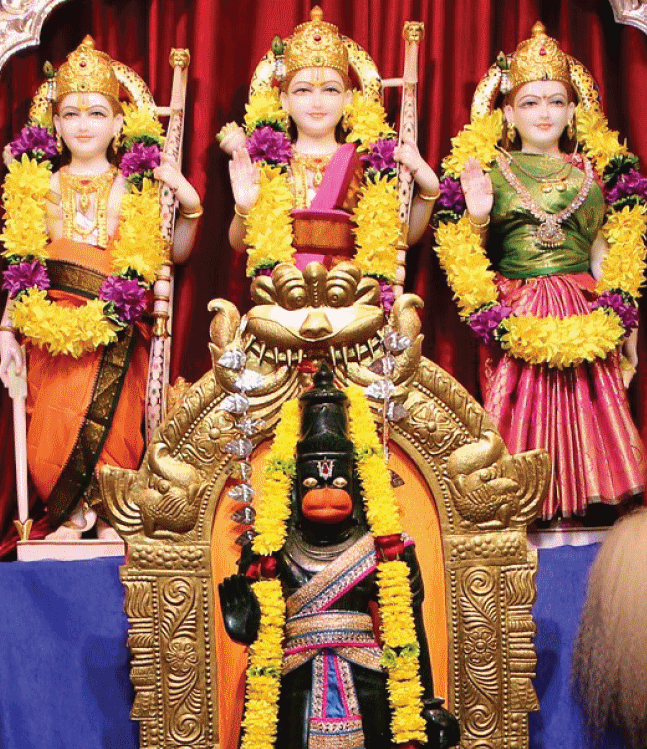
Sri Ram Parivar
Sri Ram is the 7th incarnation of Lord Vishnu. The personality of Lord Ram stands out unique and the most glorious. Sri Ram is the peerless symbol of the highest ideal, the personification of every virtue, Maryada Purushottam, to be above reproach in every respect. Mother Seeta is an ideal woman who is not only Pativrata (faithful to husband), but also a symbolic of glory of Hindu womanhood. Lakshman characterized as the very embodiment of the principle of service.
Sri Hanuman is Chiranjeevi and is present at all times. Considered to be Para Brahma, Lord Hanuman is also a specialist in the nine types of devotion with an excellent character worthy of emulation by all. With His undying devotion, Sri Hanuman’s greatness lies in His complete selfless surrender to Lord Rama.
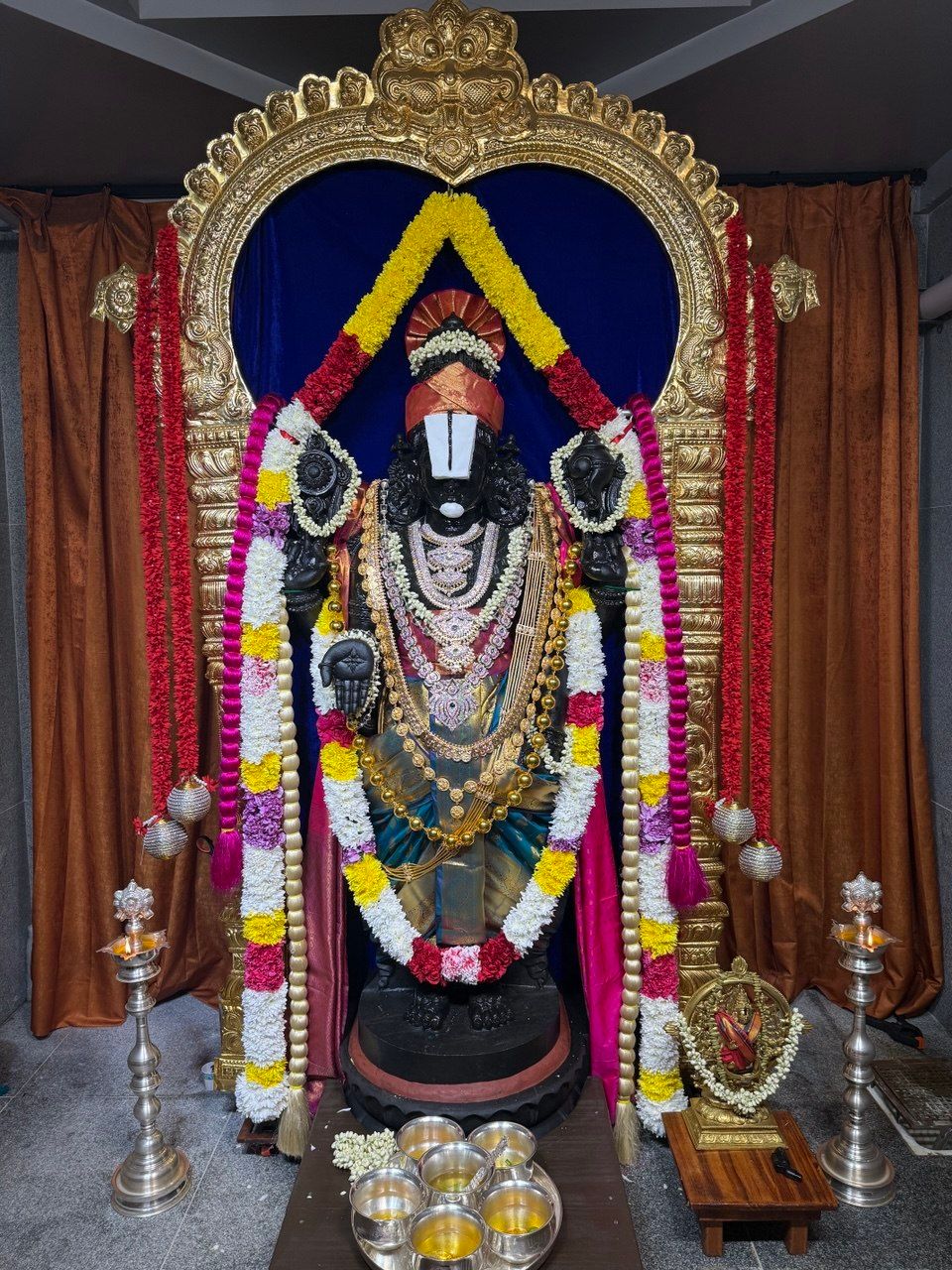
Sri Kalyana Venkateswara Swamy
Venkateswara literally means "Lord of Venkata". The word is a combination of the words Venkata (the name of a hill in Andhra Pradesh) and iśvara ("Lord"). According to the Brahmanda and Bhavishyottara Puranas, the word "Venkata" means "destroyer of sins", deriving from the Sanskrit words vem (sins) and kata (power of immunity).
Venkateswara is known by many names such as Srinivasa (in whom Lakshmi dwells), Narayana (The Primordial One), Perumal (the great lord), Malayappa (the lord of the Hill) and Govinda (Protector of Cows). In Tamil, he is commonly called "Elumalayan", meaning Lord of Seven Hills. In Telugu, he is commonly known as "ఏడు కొండలవాడా,” (Ēḍu Koṇḍala Vāḍā), also meaning the Lord of the Seven Hills. In Telugu, the hill name was 'Venkatam, Vēṅkaṭam', which is another form of 'Vaikuntam', and it follows that Lord Venkateswara means Lord Vaikunteswara or God of Vaikuntha. Vaikuntha refers to the residence of Lord Vishnu.
Other Names: Balaji, Srinivasa, Govinda, Venkatesha, Venkata Ramana, Venkatachalapati, Yedukondalavadu, Tirupati Timmappa, Perumal, Venkanna.
The Venkateswara mantra is "Om Namo Venkateshaya"
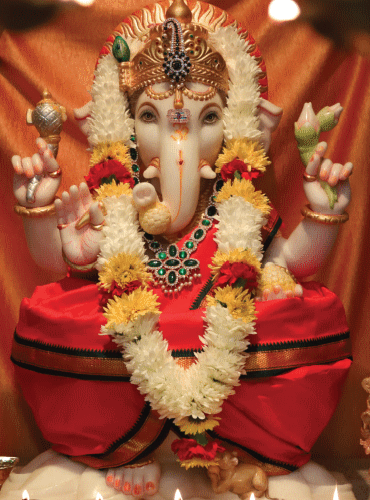
Lord Ganesha
Lord Ganesha is also known as Ganapathy and Vinayaka. Ganesha is widely revered as the remover of obstacles and is honored at the first during Hindu ceremonies. He is the son of Lord Shiva and Goddess Parvati. The broken tusk that Ganesha holds like a pen in his lower right hand is a symbol of sacrifice, which he broke for writing the Mahabharata.
The rosary in his other hand suggests that the pursuit of knowledge should be continuous. The laddoo (sweet) he holds in his trunk indicates that one must discover the sweetness of the Atman. His fan-like ears convey that he is all ears to our petition. The snake that runs round his waist represents energy in all forms. And he is humble enough to ride the lowest of creatures, a mouse.
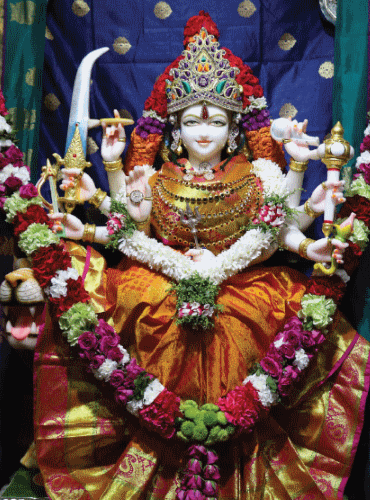
Sri Durga Mata
Sri Durga Mata is a form of Shakti and the Supreme Godhead in the form of the Mother of Creation who destroys evil forces, protects spiritual aspirants, and grants wishes. Devi presides over the Sri Chakra and helps spiritual yogic aspirants.
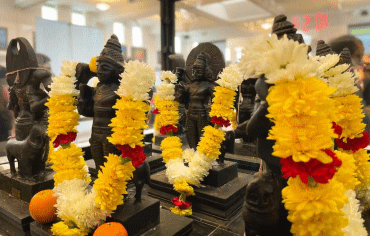
Navagraha
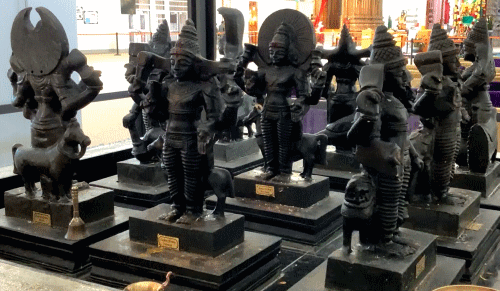
The nine (nava) major celestial bodies (grahas) of Hindu astronomy and believed to be demi-gods. These celestial bodies are named Surya (Sun), Chandra (Moon), Chevaai/Mangal(Mars), Budhan (Mercury), Guru/Brihaspati (Jupiter), Shukra (Venus), Shani (Saturn), Rahu (North Lunar Node) and Ketu (South Lunar Node). Navagraha Worship is said to alleviate certain wordly problems.
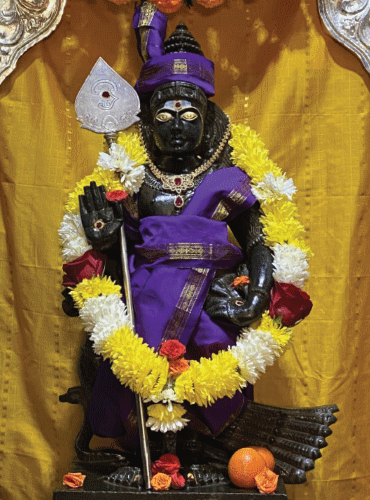
Lord Bala Subrahmanya
Lord Bala Subrahmanyam is also known as Kartikeya, Skanda, Kumaran,Subrahmanyam, Murugan and Kumara Swami. He is the commander-in-chief of the army of the devas (gods) and the son of Lord Shiva and Goddess Parvati. Symbols: Vel, the Divine Spear or Lance that he carries and his mount the peacock. He is sometimes depicted with many weapons including: a sword, a javelin, a mace, a discus and a bow although more usually he is depicted wielding a sakti or spear.
This symbolizes his purification of human ills. His javelin is used to symbolize his far reaching protection, his discus symbolizes his knowledge of the truth, his mace represents his strength and his bow shows his ability to defeat all ills. His peacock mount symbolizes his destruction of the ego.
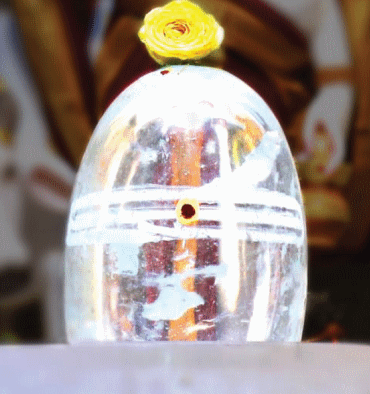
Lord Shiva
Lord Shiva is also known as Mahadeva, Nataraja, Bhairava, Vishwanath and is one of the Gods in the Hindu Trinity. Shiva plays the aspect of the destroyer of the world at the time of pralaya and is the consort of Goddess Parvati (Shakti). A maha yogi and ever in meditation, Shiva is shown with matted locks and piled atop his head like an ascetic and adorned with the crescent moon and the Ganges River trickles through the Lord’s hair and is mostly in “linga” form in Temples.
The 'Sphatika-linga' is made up of crystal. It is prescribed for the deepest kind of worship of Lord Shiva. It has no color of its own, but takes on the color of the substance which comes in contact with it. It represents the 'Nirguna Brahman' or the attribute-less Supreme Self or the formless Shiva.
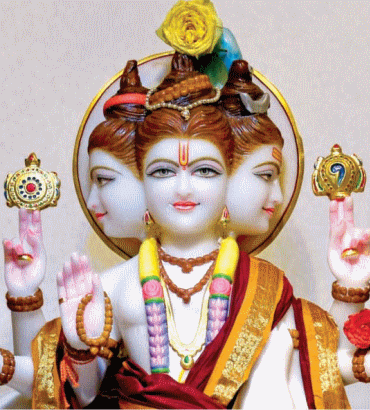
Lord Dattatreya
Lord Dattatreya is regarded as one of the most ancient deities. The 3 heads of Lord Datta are said to embody his identity as the Devas of the Trinity, namely, Brahma, Vishnu and Shiva. He is also the one who has transcended the 3 qualities or the Triguna and is one with the Sublime Energy of the Absolute Guru. This is why Datta is also regarded as the Guru of Gurus or the Divine Guru.